
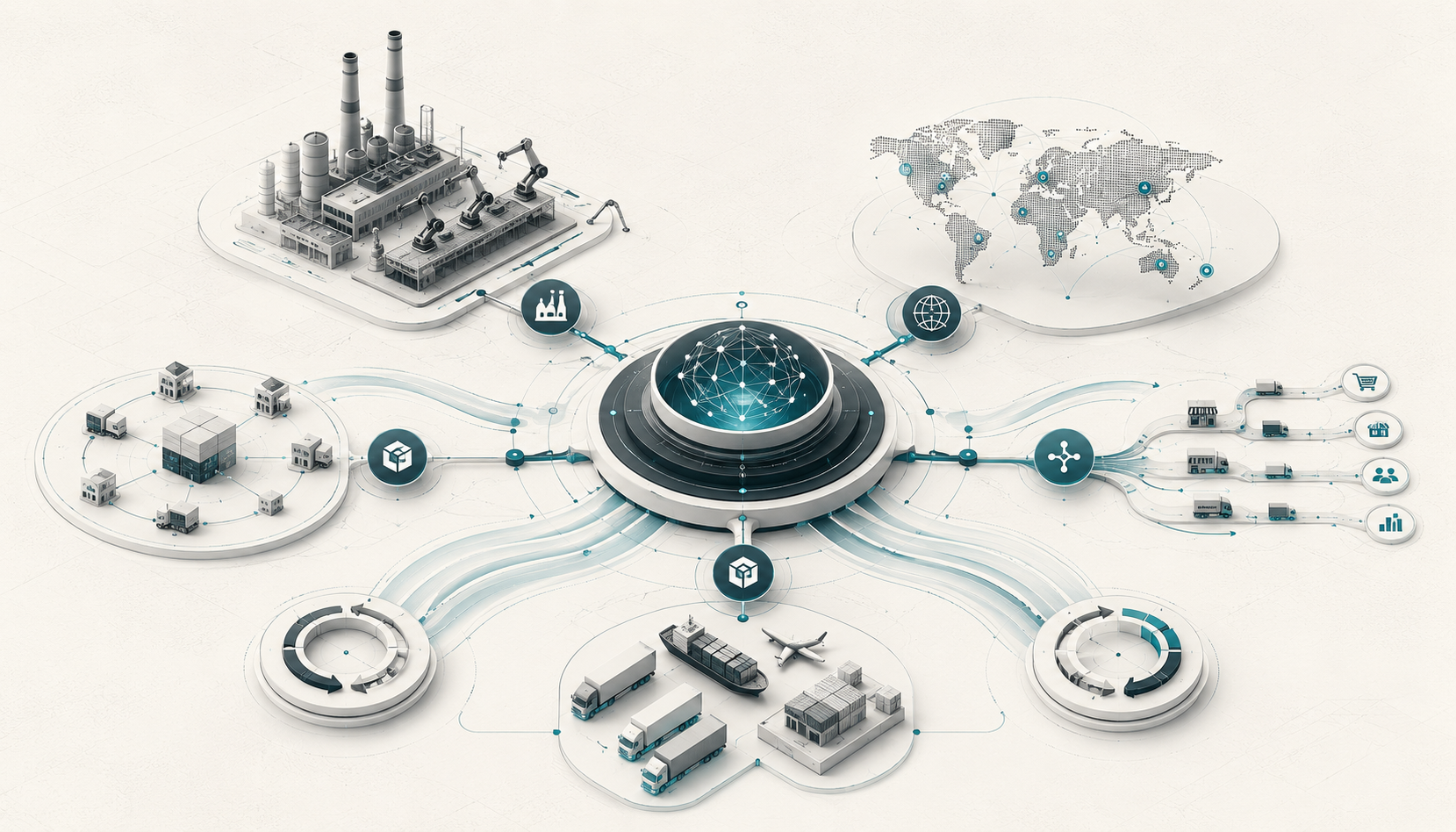
For almost thirty years, having large-scale operations was seen as the main advantage in India’s FMCG and food industry. Companies set up mega-factories near big industrial areas, focused on producing large batches, centralized their buying, and used national distribution networks to deliver standardized products across India.
That model is beginning to fracture.
Not because scale no longer matters, but because volatility now matters more.
By 2026, India’s consumer market will have become too unpredictable for rigid manufacturing setups. Demand changes quickly, regional tastes are more important, and distribution cycles are shorter. Products don’t last as long in the market. Climate issues affect sourcing, while e-commerce and quick commerce change how fast products need to be restocked. Modern retail and digital brands push for faster innovation. At the same time, global events and fluctuations in raw material prices continue to put pressure on costs.
The result is a structural manufacturing question that many FMCG and food companies are still underestimating:
Can centralized mega-factories survive in a market where demand itself has become decentralized?
For many categories, the answer is increasingly becoming “no.”
In the coming decade, having the biggest factories won’t be enough for success in India’s FMCG and food sector. The real advantage will go to companies with the most flexible and adaptive manufacturing networks.
That distinction changes everything.
The mega-factory approach was designed for a time when operations were stable and predictable.
Large production sites worked efficiently when companies could forecast demand with reasonable accuracy, maintain long production runs, standardize packaging formats, and distribute products through relatively linear channels.
But today, India’s consumer market doesn’t follow a straight or predictable path anymore.
A beverage SKU that performs well in Bengaluru may fail in Jaipur. A flavor profile successful in Tier-1 cities may need complete repositioning in Eastern India. A product launched through modern retail may suddenly see demand spikes through quick-commerce platforms. Consumer attention itself is fragmenting faster than legacy supply chains can react.
The issue isn’t about how big the factories are.
The real challenge is how quickly manufacturing can respond to changes.
Centralized production structures introduce multiple vulnerabilities in today’s FMCG environment:
In categories such as ready-to-eat foods, wellness beverages, frozen foods, dairy alternatives, protein snacks, clean-label products, and regional packaged foods, responsiveness is now becoming more valuable than pure manufacturing efficiency.
This marks a big change in strategy.
Many FMCG companies still make the mistake of treating India as just one market.
In reality, India now functions as several connected but distinct consumer markets.
Consumption behavior in Gujarat differs significantly from that in Tamil Nadu. Demand elasticity in Tier-2 Maharashtra differs from that in the urban NCR. Spice tolerance, health positioning, premiumization acceptance, packaging preferences, and purchasing frequency vary sharply across regions.
This fragmentation is accelerating because of five major structural shifts.
Quick Commerce Has Redefined Inventory Expectations
The rise of ultra-fast delivery models is fundamentally changing manufacturing logic.
Quick-commerce ecosystems prioritize:
Large centralized manufacturing hubs struggle to support these operational realities efficiently.
Distributed manufacturing closer to regional consumption clusters reduces:
This approach is especially important for foods that need to stay fresh or are temperature-sensitive.
Regionalization of Taste Is Accelerating
India’s next consumption growth wave is increasingly regional rather than national.
Consumers are demanding:
Mega-factories optimized for standardization often become structurally inefficient for such fragmentation.
Distributed manufacturing enables:
By 2026, being flexible in manufacturing will help brands grow, not just support daily operations.
Climate Volatility Is Reshaping Supply Chains
India’s food ecosystem is entering an era of climate-linked manufacturing instability.
Erratic rainfall, heat stress, crop variability, and logistics disruptions are already impacting:
Centralized production makes these risks worse because everything depends on a single location.
Distributed manufacturing networks create resilience by:
This shift is particularly critical for food processors dependent on spices, dairy, fruits, vegetables, grains, and nutraceutical inputs.
Innovation Cycles Are Becoming Shorter
Traditional FMCG product development cycles were once measured in years.
Now they are measured in quarters.
Emerging brands are launching:
Consumers are also experimenting faster than ever before.
Centralized manufacturing, which is set up for large volumes, finds it hard to adapt quickly without making operations more complicated.
Distributed manufacturing allows companies to:
In the future, the top manufacturing companies won’t always be the ones making the most products.
Instead, it could be the company that can launch and adjust products the fastest.
Distributed manufacturing does not mean abandoning scale.
It means thinking about scale in a new way.
The future-ready FMCG manufacturing network in India is likely to operate through a hybrid architecture:
This setup gives companies more flexibility while still keeping costs under control.
The most sophisticated companies are already shifting toward networked manufacturing ecosystems rather than singular production dependence.
Many executives still misunderstand distributed manufacturing as merely “having multiple factories.”
But that view is too simple.
True distributed manufacturing is an integrated strategic operating model.
A Modern Distributed Manufacturing System Typically Includes:
This idea is no longer just something for the future.
It’s quickly becoming something companies need to stay competitive.
India could become one of the world’s leading countries for distributed manufacturing in the next ten years.
Several structural advantages support this transition.
Deep Regional Consumption Density
Unlike many global markets, India has multiple independent consumption clusters with sufficient scale to justify regional manufacturing economics.
Cities such as:
These cities are turning into major consumer markets themselves, not just extensions of big metro areas.
Government-led investments in:
These efforts are slowly making it easier to expand decentralized production.
Programs aligned with food processing and manufacturing modernization are accelerating this transition. Ministry of Food Processing Industries and National Industrial Corridor Development Corporation continue to shape long-term infrastructure readiness.
India’s rapid digitalization is making distributed operational management increasingly viable.
Tools like cloud-based ERP systems, AI forecasting, IoT production monitoring, and digital procurement are making decentralized manufacturing much less complicated than before.
In 2026, manufacturing agility will increasingly be driven by data intelligence rather than physical scale alone.
For years, FMCG manufacturing strategy focused aggressively on optimization.
That framework worked in stable markets.
But volatility changes the economics of efficiency.
Now, being resilient has real economic value.
A company capable of:
may outperform a lower-cost competitor with a rigid manufacturing structure.
Many company leaders are starting to see this as a key strategic change.
In the future, the main manufacturing metric might not be “cost per unit” anymore.
Instead, it could become:
“response capability per unit of volatility.”
Not all FMCG and food categories will transition at the same pace.
Some sectors are structurally more suited for distributed manufacturing expansion.
High-Potential Segments Include:
These sectors are already showing that centralized manufacturing is becoming more limiting for their operations.
Interestingly, this shift to distributed manufacturing could create huge growth opportunities for India’s MSMEs.
Large FMCG corporations often face structural inertia:
MSMEs and emerging brands can build adaptive manufacturing models from the beginning.
This creates opportunities for:
The next wave of FMCG disruptors in India may not rely only on big advertising budgets.
Instead, they might win by being more adaptable in their manufacturing.
Distributed manufacturing is not automatically superior.
Poorly designed decentralized systems can create:
So, making this change needs careful planning and coordination.
Companies need clarity around:
This is where many organizations fail.
They decentralize operations without redesigning operating logic.
This adds complexity but doesn’t give any real strategic benefit.
The most forward-looking FMCG and food companies are no longer asking:
“How large should our factories become?”
They are asking:
“How adaptive should our manufacturing network become?”
This is a completely different way of thinking about strategy.
The next generation of manufacturing leadership is increasingly focused on:
This change is still just beginning in India.
But by 2026 and after, it will likely become one of the biggest strategic changes in India’s FMCG and food industry.
At Velox Consultants, we believe India’s manufacturing transition will not simply be driven by automation or scale expansion.
Adaptability will be the main driver.
The winners in India’s next FMCG and food growth cycle are likely to be organizations capable of synchronizing:
The time when centralized manufacturing was king is slowly being replaced by smarter, networked manufacturing.
For investors, FMCG brands, food processors, ingredient companies, and manufacturing-led startups, this transition creates critical strategic questions:
These are not just questions for operations teams anymore.
They are boardroom-level growth strategy decisions.
The companies that tackle these questions early could shape the next decade of manufacturing in India.
Many FMCG and food companies in India already have plenty of market reports, dashboards, and industry insights. The real challenge is turning these insights into actions that can scale. By 2026, the edge will go to organizations that can quickly turn information into decisions that respond to the market.
Velox Ascent Matrix: Building Execution-Ready Growth Systems
At Velox Consultants, the Velox Ascent Matrix is designed to help businesses bridge the gap between strategy and execution. The framework integrates three core growth pillars:
The goal isn’t just to find opportunities, but to help companies put them into action efficiently.
Execution-Led Consulting: From Advisory to Action
Traditional consulting usually stops at giving advice. Execution-led consulting, on the other hand, is about helping companies put plans into action, adapt, and achieve real business results.
This approach helps businesses:
For FMCG, food processing, agrifood, wellness, and D2C brands, execution is now just as important as having a good strategy.
Conclusion: Turning Insights into Decision-Grade Growth
India’s FMCG and food ecosystem is entering an era in which volatility, regionalization, and rapid shifts in consumption require faster, more adaptive decision-making.
The companies most likely to succeed in 2026 and beyond won’t just be those with the biggest factories or the most data. Success will come to those who can turn insights into real, actionable growth strategies.
Closing the gap between knowing what to do and actually doing it is now essential. It’s becoming a key advantage over the competition.
1. What is distributed manufacturing in the FMCG and food industry?
Distributed manufacturing is a decentralized production model in which companies operate multiple regional manufacturing or processing nodes rather than relying entirely on a centralized mega-factory. The objective is to improve responsiveness, reduce logistics dependency, support regional customization, and increase supply chain resilience. By 2026, it is emerging as the dominant manufacturing architecture for FMCG and food businesses operating in India's volatile consumer markets.
2. What is the difference between contract manufacturing and distributed manufacturing?
Contract manufacturing is an outsourcing arrangement where a third party produces goods on behalf of a brand. Distributed manufacturing is a network strategy that describes how production is geographically and operationally structured across multiple nodes, which may include the company's own factories, contract manufacturers, micro-processing units, and regional satellite facilities. Contract manufacturing is often one component of a distributed manufacturing strategy, but the two are not the same. Contract manufacturing answers "who makes it." Distributed manufacturing answers "where, how fast, and how flexibly it gets made."
3. Why are FMCG companies shifting away from mega-factories in India?
India's FMCG and food markets are becoming more volatile, region-specific, and demand-driven. Quick commerce, regional taste preferences, climate disruptions, shorter product life cycles, and rising freight costs are making centralized manufacturing models less adaptive. Distributed manufacturing helps companies respond faster to market shifts, reduce single-point operational risk, and support regional customization at scale.
4. Which FMCG sectors are best suited for distributed manufacturing?
High-growth sectors such as frozen foods, wellness beverages, ready-to-cook products, protein nutrition, regional packaged foods, dairy alternatives, spice processing, and D2C food brands are increasingly adopting distributed manufacturing. These categories share three traits short shelf life, regional taste sensitivity, and rapid innovation cycles, all of which reward responsiveness over pure manufacturing scale. Quick-commerce-led brands particularly benefit, as distributed networks compress replenishment cycles from days to hours.
5. How does quick commerce influence manufacturing strategy?
Quick-commerce platforms prioritize faster inventory movement, localized assortment planning, and rapid replenishment. This forces FMCG and food companies to establish manufacturing and warehousing capabilities closer to high-demand urban clusters, Bengaluru, Mumbai, Delhi NCR, Hyderabad, Pune, and Ahmedabad, to reduce lead times and improve SKU availability. Companies relying on a single mega-factory face structural disadvantages in serving quick-commerce demand, especially in fresh, frozen, and short-shelf-life categories.
6. Which Indian states are best for setting up regional FMCG manufacturing units?
The most attractive states for regional FMCG and food manufacturing typically include Gujarat, Maharashtra, Tamil Nadu, Telangana, Karnataka, Madhya Pradesh, Uttar Pradesh, and Andhra Pradesh. Selection depends on the category. Gujarat and Maharashtra lead in food-processing infrastructure; Tamil Nadu and Karnataka offer skilled labor and logistics density; and Madhya Pradesh and Uttar Pradesh provide agricultural sourcing advantages. Cities such as Ahmedabad, Pune, Hyderabad, Coimbatore, Indore, and Lucknow are emerging as strategic nodes for distributed manufacturing networks because they combine consumption density, infrastructure readiness, and policy support.
7. What are the risks of decentralized manufacturing?
Without proper strategic planning, distributed manufacturing can create operational complexity, inconsistent quality control, fragmented inventory management, margin erosion, and regulatory complexity. Companies require integrated planning systems, real-time digital visibility, standardized quality protocols, and strong ecosystem governance to scale effectively. The most common failure pattern is companies decentralizing physical production without redesigning their operating logic, which adds cost without adding agility.
8. How can MSMEs benefit from distributed manufacturing in India?
MSMEs can build flexible manufacturing ecosystems from the start without the burden of legacy infrastructure. This allows them to respond faster to shifts in regional demand, collaborate with co-manufacturing partners, scale selectively, and enter high-growth food and FMCG categories more efficiently. In many cases, MSMEs and emerging D2C brands have a structural advantage over large incumbents because they can design adaptive manufacturing networks from day one without the drag of fixed investments in mega-factories.
9. How should companies decide between centralized and distributed manufacturing?
The decision depends on product category, logistics economics, shelf life, demand variability, regional customization requirements, sourcing dependency, and channel strategy. Stable, high-volume products may still benefit from centralized manufacturing economics. Adaptive, fast-moving, regionally differentiated, or quick-commerce-led categories increasingly favour distributed models. Most modern FMCG companies are converging on a hybrid architecture strategic mega-hubs for stable SKUs combined with regional satellite units, contract manufacturing, and micro-processing nodes for adaptive categories.
10. What is the Velox Ascent Matrix, and how does Velox Consultants help businesses move from strategy to execution?
The Velox Ascent Matrix is the proprietary framework Velox Consultants uses to bridge the gap between strategy and execution for FMCG, food processing, manufacturing, healthcare, and emerging-sector clients. It integrates three pillars: Market and Consumer Intelligence (identifying demand clusters and category opportunities), Manufacturing and GTM Alignment (synchronizing production, sourcing, distribution, and channel strategy), and Scalable Execution Models (KPI-driven growth, regional readiness, operational adaptability). Velox Consultants, headquartered in Vadodara and serving clients across India and global markets, combines market research, primary research, manufacturing intelligence, GTM planning, competitive analysis, feasibility studies, and execution frameworks to help organizations convert strategic insights into measurable business growth.