
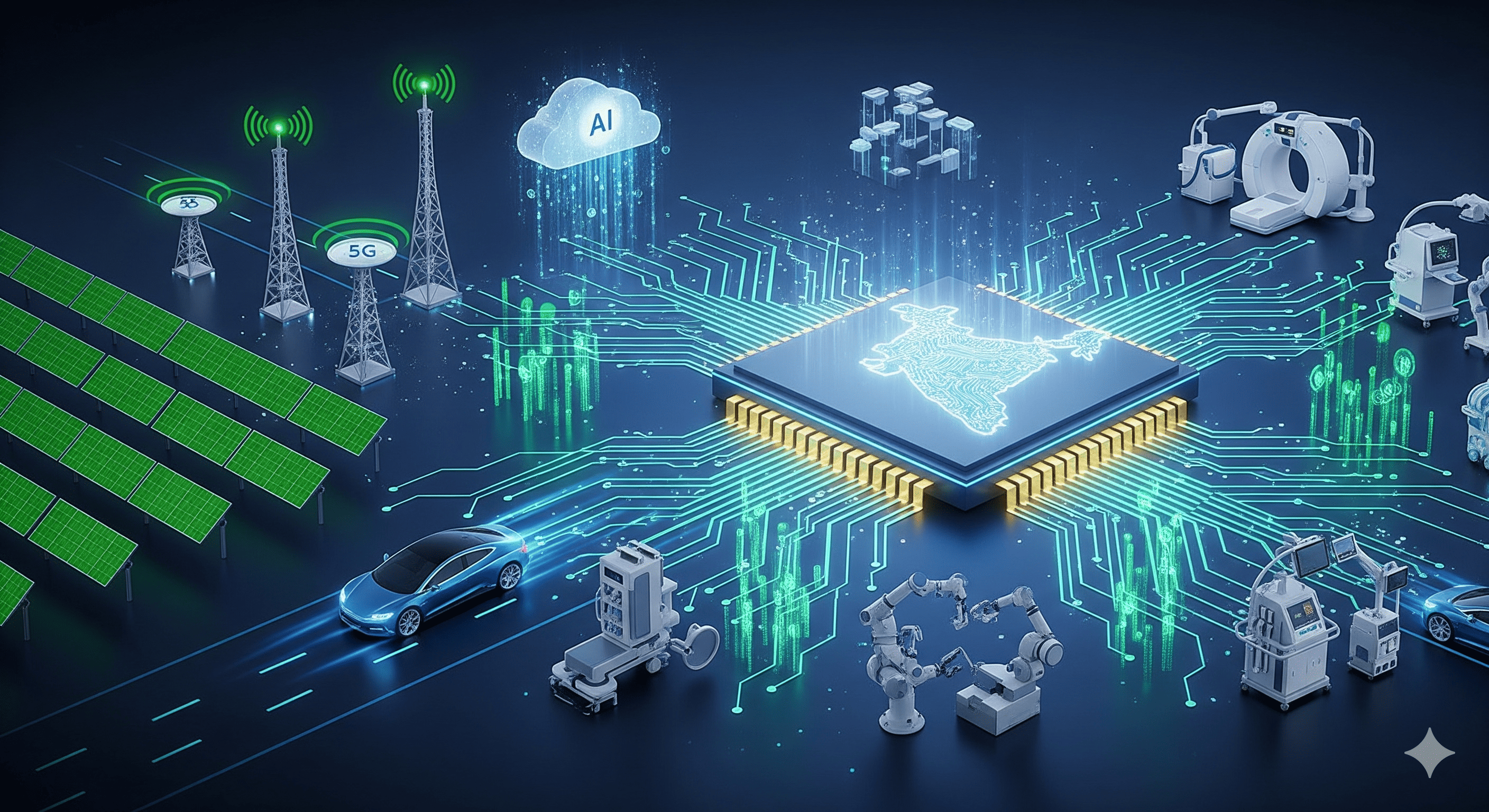
A Moment That Signals More Than Manufacturing

India’s launch of its first domestically produced chips marks a pivotal shift in its industrial landscape. This achievement signals a move from reliance on imports to becoming a creator of core technologies. It demonstrates resilience, self-reliance, and ambition, setting new competitive standards for businesses: secure supply chains, scalable innovation, and enhanced global positioning. The semiconductor revolution is now a reality, reshaping India’s growth strategy. Business leaders should act by forming strategic partnerships with local semiconductor firms and evaluating supply chain vulnerabilities to align with India’s emerging capabilities.

Beyond Announcements: A Market in Motion

While policy incentives and global partnerships remain important, India’s semiconductor market is now defined by active investment and execution. India’s talent pool, representing nearly 20% of global semiconductor design engineers, and its growing role as a resilient supply chain alternative, are accelerating ecosystem growth. However, infrastructure and regulatory challenges persist. Leaders should collaborate with policymakers to streamline regulations and invest in infrastructure upgrades. Forming industry advocacy groups and investing in local utilities can help ensure reliable resources. Proactively stress testing for risks such as water shortages or export restrictions will further strengthen resilience. India’s semiconductor sector is not about catching up, but about setting new standards that global players must address across industries.

The $110 Billion Horizon Is Not About Chips Alone

India’s semiconductor market is forecast to touch $110 billion by 2030, but that number is a proxy for something larger. It signals:

  • Global trust in India as a supply chain stabilizer in an era of disruption.
  • A design-led identity, with local IP feeding into global systems.
  • Cross-sector industrial strength, from EV batteries to healthcare devices.
  • Investor magnetism, as capital flows into ecosystems rather than isolated fabs.

This opportunity is about leadership, not just cost. India is positioning itself as a value-driven ecosystem builder, where innovation, supply resilience, and scale intersect. Unlike Vietnam and Malaysia, which focus on cost-competitive manufacturing, India emphasizes advanced design, innovation, and technology integration. While China leads in manufacturing scale and Taiwan excels in production, India’s commitment to end-to-end ecosystem development and design leadership sets it apart. The U.S. prioritizes innovation and design but faces manufacturing scale challenges. For businesses, the $110 billion projection is a call to engage with a future-ready growth engine, not just a statistic.

Why This Revolution Feels Different

India has attempted industrial self-reliance before, but this revolution is distinct. First, the timing: geopolitical realignments have forced companies to diversify supply chains away from over-dependence on a few nations. Second, the talent depth: India already contributes massively to global chip design, creating a natural pivot into manufacturing and IP ownership. Third, the capital direction: billions are now earmarked for end-to-end ecosystems, including testing, packaging, and design. Unlike past pushes, this is not about subsidies alone. It’s about confidence, from governments, investors, and enterprises, that India is no longer an optional market, but a necessary player in the semiconductor future. That confidence changes the narrative from “aspiring nation” to “rising leader.”

Opportunities Emerging With Technology and Sectoral Growth

The semiconductor revolution is not happening in isolation; it is the foundation on which India’s next decade of industrial growth will stand. The opportunities extend across multiple emerging technologies and sectors:

  • Electric Vehicles & Mobility: Chips are critical for EV batteries, battery management systems, power electronics, and ADAS systems. These applications often use specific semiconductor components such as power MOSFETs for power management and battery protection, and microcontrollers for ADAS. With India targeting 30% EV penetration by 2030, local semiconductor production can reduce import costs while boosting reliability.
  • Telecom & Next-Gen Networks: The rollout of 5G and preparation for 6G require semiconductors for network equipment, base stations, and IoT devices. India’s telecom expansion ensures sustained demand.
  • AI, Cloud & Generative Technologies: As AI adoption grows in enterprises and consumer applications, demand for GPUs, TPUs, and accelerators will surge. This is where India’s design strength can lead to exportable IP.
  • Healthcare & MedTech: Chips will power everything from wearables and diagnostic devices to robotics in surgery. With India’s health-tech sector growing at double digits, local chip innovation can redefine affordability and access.
  • Defense & Aerospace: Semiconductors are now a national security priority. Indigenous radar, avionics, and satellite communication systems depend on reliable local chip supply.
  • Smart Manufacturing & Industry 4.0: Chips underpin robotics, predictive maintenance, and IoT-driven factories. Indian MSMEs entering Industry 4.0 will require cost-effective and secure chip supply.
  • Green Energy & Smart Infrastructure: From smart grids to solar inverters and hydrogen electrolyzers, chips will shape how India scales renewable energy.

For leaders, the message is clear: all high-growth sectors in India now rely on semiconductors. Participation in this ecosystem is essential for future relevance. Leaders in healthcare and energy should identify where semiconductor technology can provide a competitive advantage. For instance, healthcare companies can partner with local semiconductor firms to develop advanced diagnostic equipment, while energy sector leaders can collaborate on more efficient, semiconductor-enabled energy management systems.

In the telecom sector, businesses should integrate semiconductors into 5G network infrastructure to enhance connectivity and drive IoT growth. In manufacturing, especially automotive, companies can use semiconductors to advance automation and precision engineering, increasing productivity and reducing costs. These actions will enable businesses to actively shape sectoral advancements, rather than passively observing the semiconductor revolution.

The Playbook for Leaders

India’s semiconductor story isn’t just about building fabs; it’s about how leaders position themselves in this ecosystem. To stay ahead, here’s the actionable playbook structured around Agility, Adaptability, and Alignment:

Agility: Reframe Growth by stopping the view of semiconductors as a standalone industry. Treat them as the invisible foundation for your sector’s competitiveness. If you’re involved in EVs, AI, healthcare, or energy, your next growth curve will be chip-enabled. Embrace the agility to pivot and update strategies quickly to meet market demands.

Adaptability: Capitalize on Talent by leveraging India’s design engineers who are already shaping global chip IP. Leaders who harness this base for innovation will command premium positioning. Encourage adaptability by constantly upskilling internal teams in semiconductor technologies to keep pace with industry evolution.

Alignment: Align with Ecosystems by investing in partnerships with design houses, OSAT providers, and policy-linked initiatives. Growth will come from ecosystems, not isolated plays. Position Innovation and trust by embedding these dual attributes in both product and brand narratives. Winning markets in 2030 will rely more on reliability and security than on cost.

Leaders can implement these strategies by forming consortia with academic and industry partners to drive collaborative research. Launch pilot programs for chip-enabled products to establish leadership as the sector evolves. To move from strategy to execution, identify partners based on industry needs and academic strengths, set clear objectives, and initiate pilot projects with measurable outcomes. This structured approach will help ensure coordinated and successful efforts.

  • Reframe Growth: Stop seeing semiconductors as a standalone industry. Treat them as the invisible foundation for your sector’s competitiveness. If you’re in EVs, AI, healthcare, or energy, your next growth curve is chip-enabled.
  • Narrative Leverage: Marketing “Made in India” semiconductors isn’t about nationalism alone; it’s about building global customer trust. Products backed by reliable local chips become symbols of resilience and supply security.
  • Align with Ecosystems: Invest in partnerships with design houses, OSAT providers, and policy-linked initiatives. Growth will come from ecosystems, not isolated plays.
  • Capitalize on Talent: India’s design engineers are already shaping global chip IP. Leaders who harness this base for innovation — not just cost advantage — will command premium positioning.
  • Position Innovation and Trust: Winning markets in 2030 will not depend on who is cheapest, but on who is most reliable, secure, and forward-looking. Leaders must embed this duality in product and brand narratives.

This playbook sets the ground rules: adapt now, or risk irrelevance as India’s semiconductor tide rises.

From Policy to Profitability and Global Positioning

India’s semiconductor progress will be measured by both manufacturing capacity and its ability to position itself globally. While policy provides the foundation, profitability and trust depend on effective positioning. The government’s incentives, such as the PLI scheme, capital expenditure subsidies, and skill development initiatives, create a supportive environment. Infrastructure support and streamlined regulations further enhance investment appeal. Compared to global peers, India’s focus on ease of doing business and talent development offers a competitive edge. India must shift from manufacturing to leading supply chains and designing ecosystems. The true success of this revolution will be defined by whether Indian semiconductors become synonymous with reliability, innovation, and resilience. Each chip produced signals India’s intent to compete and lead globally.

Velox Consultants’ Perspective

At Velox Consultants, we see three defining forces shaping India’s semiconductor trajectory:

  • Resilience First: Distributed fabs and supply-chain diversification are becoming essential for global stability.
  • Innovation at Scale: Pilot projects are rapidly converting into commercial ecosystems, spanning fabrication to design IP.
  • Capital Redirection: Smart money is shifting from isolated manufacturing to integrated value chains in chips, smart infra, and AI-driven solutions. Consider the recent shift by Spark Capital, which redirected its investments from a standalone fab to an integrated OSAT and design center in Bangalore. This move encapsulates the growing trend of investors seeking comprehensive ecosystem engagements over isolated plays, inspired by the promise of greater value and interconnected growth.

This is not just a technological race. It is a narrative race. India’s ability to market its semiconductor story as a brand of resilience + innovation will be the difference between incremental gains and global dominance.

FAQs on India’s Semiconductor Revolution 

Why is India’s semiconductor push important now?

Global supply chains are shifting, and India offers both scale and design talent. Velox sees this as a once-in-a-generation opportunity for businesses to embed resilience and innovation in their strategies.

How big will India’s semiconductor market be by 2030?

It is projected to reach $110 billion, fueled by demand across EVs, AI, telecom, healthcare, and defense. Velox forecasts growth not only in fabs but in IP design and smart infrastructure.

Which sectors in India will benefit most from semiconductor growth?

EVs, telecom (5G/6G), AI and data infra, healthcare, aerospace, smart manufacturing, and green energy will see the most immediate benefits. Velox recommends businesses in these verticals to act early.

Is India only focusing on manufacturing fabs?

No. The ecosystem covers fabs, OSAT (assembly/testing), design IP, and global partnerships. Velox highlights design and packaging as underappreciated but high-growth opportunities.

What opportunities does this create for businesses in India?

Opportunities range from supply chain integration to chip-enabled product development and securing investor capital. Velox advises firms to align early with semiconductor-linked ecosystems to capture value. 

How will India’s chip revolution impact global markets?

It will diversify supply chains, reduce over-dependence on traditional hubs, and position India as a cost-competitive, design-led innovation hub.

What role does policy play versus private investment?

Policy provides incentives and infrastructure, but private investment decides sustainability. Velox believes the winners will be those who convert policy openings into profitable, scalable ventures.


 

Tags
Market Research Technology Marketing Strategy AI Market Analysis Manufacturing Healthcare Retail Fintech Sustainable Energy Renewable Energy MSME Growth MSMEs in Smart Manufacturing Telemedicine Future Of Healthcare IoT Pharmaceutical Food MSME Clusters Clean Energy Sustainability Metaverse Consumer Goods Automotive Power Sustainability in MSME Digital Twin Industry 4.0 India Smart Factory Market Next-Generation Sequencing Space cleantech net zero by 2030 D2C Healthcare industry Artificial Intelligence Retail Marketing Distributed Energy Resources (DER) Branding Agriculture Infrastructure Global FMCG Trends Data Centres & AI Compute Growth Growth Strategy 2025 Delhi FMCG strategy FMCG India India FMCG Strategy Consumer Insights Growth Strategy agri business models agri-tech innovation Retail Innovation market research for SMEs Healthcare Trends Digital Transformation Green Practises in MSMEs Regional MSME Clusters Advanced Manufacturing smart factory Market research trends AI in market research Predictive analytics Medical Equipment AI in Healthcare Electronic Manufacturing Service Genomic Sequencing CRISPR Gene Editing COP 28 Product Market Fit Strategy DeepTech Quantum Computing Biotechnology Space Mining Satellites Bio-fabrication in Space Wearable medical devices Generative AI green hydrogen production future of hydrogen energy Advantages of Hydrogen for Power Generation Hydrogen Production Hydrogen Policy Cybersecurity Engineering smart mobility Supply Chain Entertainment CPG BFSI zero carbon emission wealthtech Insurtech Neo Bank Online Food Delivery Health and wellness Telecom India Economy 2026 Velox Consultants AI in Manufacturing Atmanirbhar Bharat India Pharma 2026 Green Energy India Semiconductor India Consumption to Capability India Business Strategy Viksit Bharat india-uae-business b2b-growth-strategy global-market-entry middle-east-market cross-border-trade india-export-strategy gcc-expansion abu-dhabi-investment dubai-business-opportunities uae-market-entry Supply Chain Localization Export-Oriented Manufacturing Engineering Goods India Pharma & Chemicals Manufacturing Industrial Policy India 2026 MSME Growth Strategy Manufacturing Investment India Gujarat Industrial Clusters India Manufacturing Corridor India Europe FTA sectors analysis Europe expansion strategy for Indian companies Growth strategy for international market entry Market research for Europe expansion India Europe market entry strategy ESG compliance for Europe exports Data Center Market Research AI Infrastructure Strategy Global AI Data Centers AI Investment & M&A Enterprise Digital Infrastructure India AI Infrastructure Sovereign AI & Policy Power & Cooling Constraints Hyperscale & Colocation Wellness Drinks Functional Beverages Export Market Intelligence Consumer Health Trends Food & Beverage Strategy Preventive Health Nutrition Beverage Industry Trends Gut Health Beverages Ayurveda Export Market Die-Cast Aluminium Market High Pressure Die Casting EV Aluminium Components Export Ready Manufacturing Global Aluminium Supply Chain Low Carbon Aluminium Sustainable Aluminium Manufacturing Manufacturing Capacity Expansion Aluminium Battery Enclosures Lightweight Automotive Materials Advanced Die Casting Technologies Structural Aluminium Castings Large Format Die Casting business growth trade policy impact international market entry strategy manufacturing expansion, export growth opportunities global sourcing shift international procurement tariff disruption strategy export diversification global value chains Autonomous Operations Smart Manufacturing Innovation Acceleration Future of Work AI Strategy Enterprise AI Adoption Autonomous Intelligence Agentic AI Skincare Innovation Digital Cosmetics Clean Beauty Beauty & Wellness Anti-Aging APAC Market Cosmetic Trends 2030 Sustainable Skincare AI in Beauty Satiety Economy FMCG Strategy GLP-1 Supply Chain Innovation Functional Foods Consumer Behavior Supplier and distributor intelligence Vendor Intelligence B2B Market Research Engineering Product Market Research Energy Market Research FMCG Market Research Healthcare Market Research Healthcare & MedTech India 2026 Functional Foods & Agri Innovation Green Hydrogen & Clean Energy Transition EVs & Battery Circular Economy India Semiconductor & Electronics Manufacturing India AI SaaS & MSME Digitization India Investment Opportunities Boardroom Strategy India India 2026 Growth Playbook ClimateTech & Carbon Markets India Healthcare Tech Telecom 6G Telecom 5G EV Mobility AI Chips India Semiconductor Market Semiconductors Green Energy Electricals Automation Emerging Markets Smart Factories Cobots over Robots Energy Reliability Gap Green Electricals Smart Cities Green Transport PM E-Drive Battery Swapping Charging Stations India Mobility EV Infrastructure Electric Vehicles Power sector transformation Smart meters and IoT Energy storage and AI Clean energy transition AI smart grids Farmer Empowerment Rural India Pharma Engineering CMO Insights Velox Ascent Matrix Strategic Consulting for Manufacturers MSME Strategy UAE SME & MSME Consulting Marketing Transformation Tier 2 CPG insights Chennai beauty market trends Ahmedabad regional GTM Personalized Wellness Mumbai CPG personalization Regional Marketing Primary Research CPG Trends 2025 India personalization expert healthtech trends 2030 green hospitals quantum-AI drug discovery bio-digital twins global health trends sustainable healthcare systems quantum AI healthcare regenerative medicine insights digital health innovation Sustainable Growth Business Transformation Retail Growth Strategy Consumer Product Strategy B2B Strategy Growth Matrix Velox Framework Startup Consulting MSME Strategy Functional agriculture nutraceutical exports supply chain in agriculture functional food market wellness foods food-tech sourcing India nutrition economy bio-fortified crops Smart Retail Velox Insights AI in Business Future Of Commerce India Retail Trends Retail Growth 2025 Retail Growth Consumer Intelligence Retain AI Strategic Foresight Zero Defect Zero Effect National Digital Twin Predictive Manufacturing Simulation Tech SME Insights MSME Insights Robotic Surgery Healthcare Technology Minimally Invasive Surgery Surgical Robotics Future of Surgery Healthcare Investments Medical Innovation AI Investment Union Budget 2025 Export Global Business Trends DAVOS 2025 economic resilience Intelligent Manufacturing Sustainable Mobility MSME Export Trends Government Schemes for MSMEs Indian Economy Cloud Computing Smart Factory Technologies Manufacturing Excellence Biosimilars Biologics CRISPR-Cas9 AI in Pharma Pharmaceutical Engineering Pharmaceutical Market Trends Sustainable Pharma Advanced Drug Delivery Real-time insights Digital qualitative research Market intelligence Ethical research AI in Green Finance Blockchain for Sustainability Eco-friendly Investments Sustainable Finance Green Fintech Energy Efficiency Smart Grids Quantum Dots Nanobots Nanomaterials Nanomedicine Nanotechnology Nanofabrication Nano-Fertilizers Carbon Nanotubes Quick Commerce E-commerce Data Driven Personalization Healthcare Innovation MedTech Personalized Medicine Digital Health 3D Printing in Healthcare Robotics in Surgery Carbon Storage System Carbon capture technology Robo Advisor Insurance Finance Banking Biotech CRISPR DigitalTherapeutics Decentralized Finance Contactless Payments Open Banking Traditional Banking Embedded Finance Pharma Innovation Digital Therapeutics Patient Engagement Pharma CX Green Electronics Green Technology Mass Customization Micromobility Vehicle-to-grid (V2G) technology Wireless Charging Battery Advancements Powertrain Optimization Emobility Collaborative Robots Microfactory Bioinformatics Pharmacogenomics Disease Prediction Personalised Medicine Genomics ClimateTech Carbon Capture and Removal Sustainable Transportation Circular Economy Market-Fit Strategy D2C Strategy Human-Machine Interaction Digital Thread Edge Computing Genetic Engineering 3D Bio Printing Space Tourism Aerospace Tissue engineering Organ Transplantation Customised Implants Customised Prosthetics Disease Modeling Regenerative Medicine ECG monitors Wearable health Telehealth Mental health monitoring Fall detection Pregnancy monitors Blood pressure monitors Product Design Content Creation chatgpt WEB 3.0 Invest India India Market startups ESG Electronic Waste Construction Waste Agriculture Waste Water Waste Renewable Energy Waste Plastic Waste Semiconductor Use Semiconductor Transport Surveillance Security Logistics drone technology Innovation Virtual Factory nft ev battery recycling co2 emissions automotive and transporat EV Charging Station Electric Car Charger Charging Car Nordics Robo-Advisor Digital Banking Cloud Kitchen B2B virtualclassrooms elearning education edtech Telemedicine Market Size Telemedicine Market Growth Telemedicine Market Telemedicine Benefits Reshape the Healthcare Internet of Things 3-D Printing Textile Crude Steel Capital goods Automobile Airports Steel Customer Acquisition Tractor IT Pricing Strategy 5 Cs PESTEL Analysis SWOT Analysis 8 Ps