
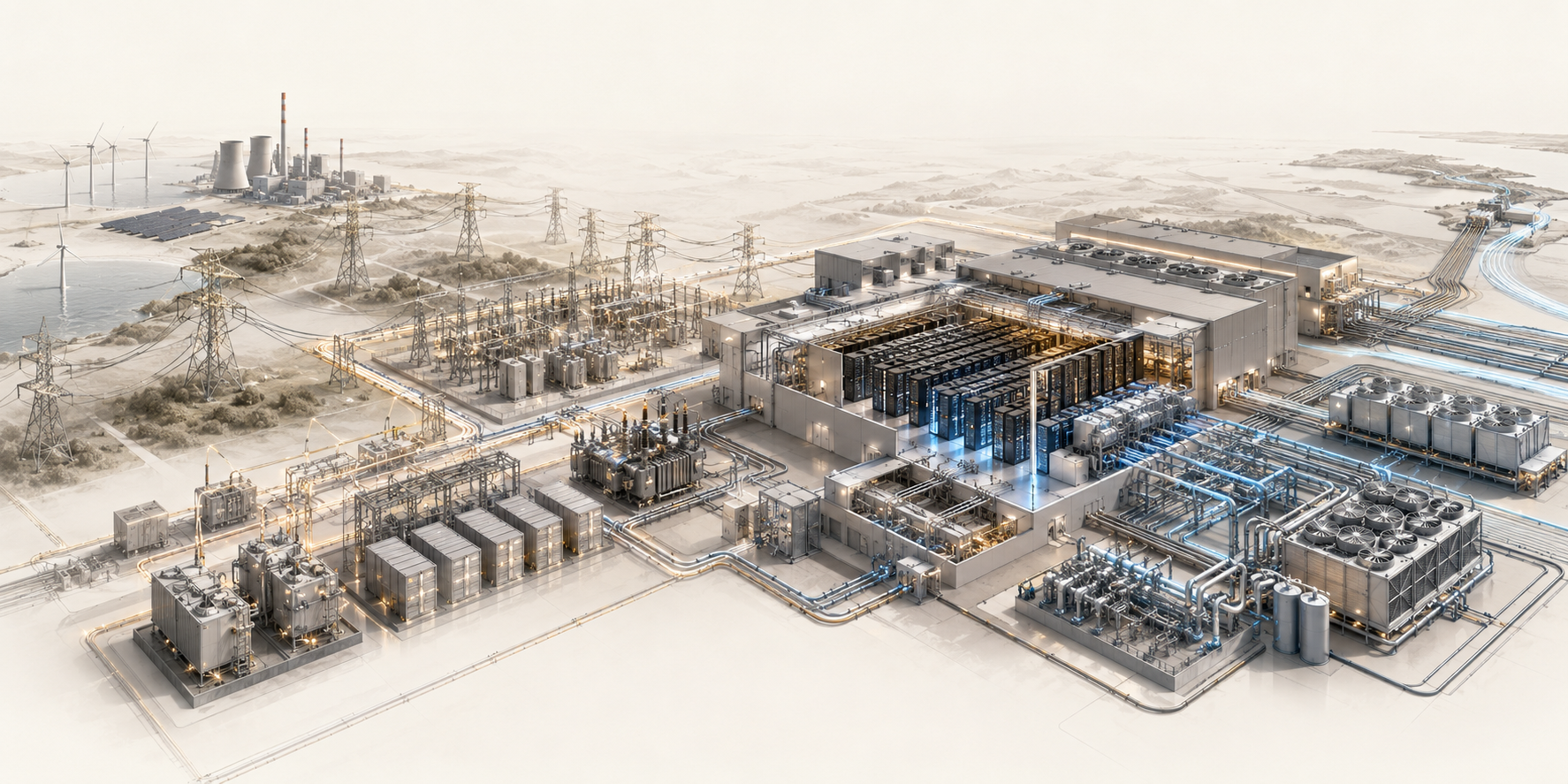
For much of the artificial intelligence boom, attention has concentrated on the most visible elements of the ecosystem: GPUs, foundation models, hyperscalers and the technology companies building increasingly powerful AI systems.
The next phase of the market is likely to be shaped by something far more physical.
That changes how the AI data center market should be evaluated.
The central question is no longer simply how much computing capacity companies want to deploy. Increasingly, it is: how much of that capacity can actually be powered, cooled, connected and commissioned within a commercially acceptable timeframe?
The International Energy Agency expects global data-centre electricity consumption to roughly double from 485 TWh in 2025 to around 950 TWh by 2030. Electricity use from AI-focused data centres is expected to increase even faster, tripling over the same period.
At the same time, infrastructure is struggling to keep pace. The IEA estimates that grid constraints could
delay approximately 20% of global data-centre capacity planned for construction by 2030.
These are more than energy statistics. They point to a structural change in the economics of AI
infrastructure. The next competitive advantage may not simply belong to whoever can acquire the most compute. It may belong to whoever can secure the infrastructure required to make that compute usable.
An AI data center is not simply a conventional data center containing more powerful servers. The workload changes the physical infrastructure around the compute.
Traditional data centres were primarily designed around general-purpose computing, enterprise applications, web hosting, storage and databases. AI infrastructure must increasingly support accelerated computing for model training and inference, high-speed GPU interconnection, greater network throughput and considerably higher concentrations of electrical power.
Velox Consultants' underlying AI Data Center Market research characterises this as a shift from infrastructure primarily supporting information access and storage toward infrastructure supporting intelligence generation. The implications extend across computing architecture, storage, networking, power density and thermal management.
This distinction is strategically important. Adding AI capacity affects much more than servers. It affects electrical architecture, substations and transformers, cooling systems, energy availability, facility design, connectivity, backup and storage infrastructure, capital expenditure and ultimately site selection.
In other words, the AI data center is evolving into a tightly integrated energy + engineering + computing infrastructure system. And that significantly expands the commercial opportunity surrounding AI.
Power has always mattered to data centres. What is changing is its strategic importance.
Historically, electricity was primarily viewed as an important operating-cost and reliability variable. In the AI infrastructure environment, it can determine whether a project is viable in the first place.
A site may offer attractive land, strong connectivity, competitive taxes and proximity to customers. But if sufficient electricity cannot be secured within the required development timeframe, those advantages may become secondary.
This is why Velox Consultants uses the concept of Power Sovereignty when analysing emerging AI infrastructure opportunities.
Power Sovereignty does not imply complete independence from the grid. It means having sufficient control and visibility over the power equation to support the commercial objective.
How much electricity is available and how much additional capacity can realistically be secured.
The expected grid-connection timeline and exposure to transmission constraints.
Electricity-cost visibility, redundancy requirements and low-carbon power availability.
Storage potential, behind-the-meter generation options and long-term expansion capacity.
The result is a fundamental change in site economics. A location with inexpensive land but an uncertain five-year power pathway may be less attractive than a higher-cost location capable of becoming operational materially sooner. Power availability is therefore moving from the engineering appendix of a feasibility study into the front end of the investment decision.
AI infrastructure and electricity infrastructure operate on very different clocks. Computing technology can change within months. Data centres can be developed within a few years. Major electricity infrastructure generally cannot.
The IEA estimates that planning, permitting and completing new grid infrastructure can require approximately 5 to 15 years, while a new data centre may be developed within roughly 1 to 3 years.
For investors, developers and infrastructure suppliers, this makes time-to-power a strategic metric. It also means announced capacity needs to be treated carefully.
A project may exist in a development pipeline. Land may have been acquired. Investment may have been announced. Demand may appear strong. But none of this necessarily means the facility can secure the required electricity connection within its expected commercial window.
That distinction becomes particularly important when companies compare countries or regions. A large market with significant announced capacity may look highly attractive from the top down. But a smaller geography with available generation, shorter grid timelines, supportive permitting and appropriate fibre infrastructure could offer a more commercially executable opportunity.
Market demand and infrastructure readiness are not always located in the same place.
Power density creates another physical challenge: heat. As accelerated computing becomes more concentrated, conventional approaches to thermal management face increasing pressure.
Velox Consultants' underlying research identifies a transition from conventional air cooling toward hybrid and liquid-based architectures as AI computing density rises. There is no single rack-density threshold at which one cooling architecture becomes universally mandatory. Appropriate solutions depend on workload, hardware, facility design, operating environment and economics.
But the direction of travel is increasingly clear. The U.S. Department of Energy's ARPA-E COOLERCHIPS programme is developing cooling technologies specifically for high-density computing systems. Its programme target is to reduce total cooling-energy expenditure to less than 5% of a typical data centre's IT load.
The commercial implication is significant. Cooling is no longer simply something addressed after the computing architecture has been chosen. It increasingly influences facility layout, rack configuration, server compatibility, usable compute density, electrical infrastructure, water requirements, floor loading, capital expenditure, operating expenditure and future upgrade potential.
This creates opportunities across direct-to-chip cooling, coolant distribution units, heat exchangers, pumps, controls, immersion technologies and specialised engineering services. But it also creates risk. A facility designed for yesterday's density profile may not necessarily be economically suited to tomorrow's AI workload. That makes AI-ready retrofit potential an increasingly important consideration when evaluating existing data-centre assets.
Another issue is often lost when the industry is discussed simply as “AI compute.” Not all AI workloads create identical infrastructure requirements.
Model training and inference have different utilisation patterns, latency considerations, geographic requirements and economic drivers. Large-scale training can favour extremely concentrated computing environments capable of supporting vast clusters of accelerators. Inference, however, increasingly moves computing closer to where applications, enterprises and users operate.
This distinction could materially influence the future geography of AI infrastructure. Instead of assuming that one type of mega-campus will dominate every workload, companies should increasingly ask: what workload will this infrastructure serve?
That question affects decisions around location, latency, networking, power density, redundancy, capacity utilisation, data sovereignty and customer proximity.
In our view, separating training demand from inference demand is becoming increasingly important when evaluating the long-term commercial attractiveness of a data-centre market. A market may not become a global frontier-training hub and can still develop a substantial opportunity around enterprise inference, sovereign compute, cloud services or industry-specific AI applications.
The changing infrastructure requirements are also altering government policy. Compute is increasingly being treated as strategic economic infrastructure. In some countries, the debate extends further - to technological sovereignty, resilience, energy security and national competitiveness.
The United Kingdom's AI Growth Zones provide one example. The programme is explicitly intended to unlock AI-enabled data-centre investment through improved access to power and planning support.
Japan's Watt-Bit Collaboration goes further in recognising the infrastructure convergence taking place. METI and the Ministry of Internal Affairs and Communications established the initiative to improve coordination between electricity, telecommunications and data-centre development.
The European Union is simultaneously building AI compute capability while imposing greater sustainability transparency on data centres. Under Commission Delegated Regulation (EU) 2024/1364, operators of facilities with at least 500 kW of installed IT power demand fall within the reporting framework for specified sustainability information and performance indicators.
India is expanding public AI compute capacity through the IndiaAI Mission. In March 2026, the Government of India reported that more than 38,000 GPUs had been onboarded for the common compute facility.
Singapore is taking a different approach because of its physical constraints. Its Green Data Centre Roadmap aims to facilitate at least 300 MW of additional capacity in the near term, with further expansion linked to green-energy deployment and energy efficiency.
Across these markets, the specific policies differ. The broader signal does not. AI compute is moving closer to the centre of energy, technology and industrial policy.
For market entrants, policy analysis can therefore no longer stop at incentives and tax structures. The more useful question is whether government policy is helping create an ecosystem in which new compute capacity can actually be powered, connected, permitted and operated.
Much of the market narrative concentrates on hyperscalers, colocation providers and the companies financing new campuses. From an industrial strategy perspective, that tells only part of the story.
Every new block of high-density compute requires an enabling infrastructure layer. More power- intensive computing requires transformers, switchgear, substations, UPS systems and power- distribution architecture. Greater thermal intensity increases demand for advanced cooling. Grid constraints increase interest in battery storage, microgrids, behind-the-meter generation and intelligent energy management. Large compute clusters require high-capacity network connectivity. More complicated facilities require specialised design, integration, commissioning, monitoring and maintenance.
Velox Consultants' underlying syndicated research consequently identifies the services layer as an increasingly important part of the ecosystem as the physical infrastructure becomes more complex to deploy and operate.
This suggests that some of the most attractive AI infrastructure opportunities may exist one or two layers away from the most visible part of the market. For industrial manufacturers, engineering companies and infrastructure technology providers, the opportunity is not necessarily to become a data-centre developer. It may be to become indispensable to the developer.
This is where macro-level market analysis often becomes insufficient. A rapidly expanding market does not automatically mean that every supplier has an attractive opportunity. Customers do not purchase CAGR. They purchase solutions to operational problems.
In the AI data-center ecosystem, these problems increasingly relate to how rapidly usable capacity can become operational, whether sufficient power can be secured, whether the design can accommodate higher-density workloads later, how cooling requirements will evolve, what level of uptime can be guaranteed, how exposed the operation is to electricity-price volatility, whether the infrastructure can satisfy regulatory and data-sovereignty requirements, and whether investment made today will remain technically viable five years from now.
For technology and equipment suppliers, this changes how the proposition should be positioned. A transformer manufacturer is not simply selling a transformer. A cooling company is not simply selling cooling capacity. A power-management company is not simply selling software.
That is a fundamentally different commercial conversation. And it is one of the reasons primary research becomes essential when evaluating this market.
One of the limitations of analysing a fast-moving infrastructure market exclusively through published data is that macro indicators can make almost every part of the market appear attractive.
Investment is rising. Compute requirements are increasing. Power consumption is increasing. Governments are supporting AI infrastructure. Those facts are important. But they still do not answer the question a management team ultimately needs answered: where is the opportunity actually executable?
During a recent Velox Consultants research programme focused on the AI data-center ecosystem, we supplemented secondary analysis with primary discussions involving relevant industry experts and market participants.
The purpose of those discussions was not to ask whether AI data centres would grow. That conclusion was already visible in the secondary evidence. Instead, the research focused on the issues underneath the headline growth story: infrastructure readiness, technology requirements, operational bottlenecks and the variables influencing commercial decisions.
Individual participants and organisations remain confidential, and the observations below are directional rather than verbatim quotations.
Insight 1: Site Selection Is Becoming Power-FirstOne of the strongest themes was the increasing importance of evaluating power availability before progressing too far into conventional site-selection analysis. Historically, site evaluation might begin with land, connectivity, market proximity, development costs and incentives before power considerations were fully developed. For high-density AI infrastructure, that order is increasingly difficult to sustain.
What it means: market opportunity should increasingly be evaluated against energised or realistically energisable capacity, not simply announced development pipelines. A geography can have significant theoretical demand while still having limited near-term buildability.
Insight 2: Grid Connection Risk Can Change an Otherwise Attractive Investment CaseOur research also reinforced the distinction between electricity generation and actual grid accessibility. A region may generate sufficient electricity in aggregate while still facing local transmission, substation or interconnection constraints. This became particularly relevant when examining development timelines.
What it means: “available electricity” and “available power at the project location” should not be treated as the same metric. For developers and investors, the gap can materially affect project timing. For equipment and infrastructure suppliers, however, the same constraint can create opportunities around substations, transformers, storage, power optimisation and alternative energy architectures. What appears to be a bottleneck at one level of the value chain can become an addressable opportunity at another.
Insight 3: Cooling Readiness Is Becoming a Future-Proofing QuestionExpert discussions also reinforced that thermal architecture needs to be considered earlier when evaluating AI-ready facilities. The question is not simply whether an existing cooling system can accommodate today's workload. It is: what happens if computing density rises materially during the economic life of the asset?
What it means: for new developments, thermal infrastructure should increasingly be evaluated against future workload scenarios rather than only initial deployment specifications. For existing facilities, this creates a new strategic issue: AI retrofit readiness. Some conventional data-centre assets may have attractive location and connectivity but require significant electrical and thermal modification before supporting high-density AI workloads economically. That can materially change asset valuation and investment priorities.
Another recurring research theme was the need to distinguish the infrastructure economics of training from those of inference. Extremely large training environments may reward scale, power concentration and specialised architecture. Inference can create different requirements around latency, geographic distribution, enterprise proximity and workload utilisation.
What it means: a market that appears secondary when measured purely by hyperscale training capacity could still become highly attractive for regional inference, enterprise AI or sovereign-compute infrastructure. This makes workload segmentation critical to geographic prioritisation.
Insight 5: Customers Are Increasingly Buying Infrastructure OutcomesPerhaps the most commercially important observation concerned supplier positioning. Technical specifications remain critical, but customers ultimately evaluate infrastructure according to the outcome it enables.
Across the research, the relevant commercial considerations increasingly converged around time-to- capacity, uptime, energy-cost stability, scalability, compliance and the risk of investing in infrastructure that becomes technically constrained before the end of its economic life.
What it means: companies entering the AI data-center ecosystem should avoid positioning themselves solely around product features. The stronger proposition answers a different question: what strategic or operational risk does our product remove for the customer? That shift can materially change product strategy, pricing, sales conversations and even the type of buyer a supplier should target.
These discussions changed the way we believe AI data-center opportunities should be evaluated. A traditional market assessment might prioritise countries according to market size, announced investments and forecast capacity. A decision-oriented assessment needs additional filters.
At Velox Consultants, we increasingly think about the opportunity through three intersecting dimensions:
The largest theoretical market does not necessarily represent the best opportunity. A smaller market where all three conditions align may create a significantly stronger investment case.
This recent research also reinforced why we do not believe major market-entry recommendations should rely on one information source. Official statistics can tell us how power demand is changing. Government documents can reveal policy direction. Project databases can identify development pipelines. Competitor intelligence can establish who is active.
But direct engagement with market participants can reveal something different: how decisions are actually being made.
That is where assumptions can be tested. Is the buyer genuinely experiencing the problem identified in secondary research? Does the problem have budget attached to it? Which specifications matter most? What prevents switching suppliers? Which projects have moved from announcement to procurement? What technical compromise will the customer accept? Where does urgency actually exist?
Combining those answers with secondary evidence enables a management team to move from a broad industry narrative toward a much narrower and more useful conclusion: where to compete, what to offer, which customers to prioritise and what risks need to be resolved before investing.
Our work on the AI data-center ecosystem has strengthened one conclusion above all others: the next phase of AI infrastructure will not be won by analysing compute demand in isolation.
It will be won by understanding the bottlenecks surrounding compute - and determining where those bottlenecks create commercially addressable opportunities.
For one company, that opportunity may be liquid cooling. For another, it may be transformers, substations or power-management systems. For an investor, it may be identifying locations where power certainty provides an overlooked advantage. For a data-centre operator, it may be designing infrastructure capable of supporting an evolving mix of training and inference.
That is where market intelligence becomes decision intelligence.
The first wave of the AI infrastructure cycle was defined by access to accelerated computing. The next phase is likely to be defined by the infrastructure surrounding it.
Power will matter. Grid access will matter. Cooling will matter. Energy storage will matter. Connectivity will matter. Electrical equipment will matter. Regulation will matter. And execution will matter.
This does not diminish the importance of GPUs or computing architecture. It expands the opportunity.
For developers, competitive advantage may increasingly come from securing infrastructure certainty. For industrial suppliers, it may come from removing infrastructure bottlenecks. For investors, it may come from distinguishing announced capacity from genuinely executable capacity. And for manufacturers entering the ecosystem, it may come from identifying where customer urgency is increasing faster than the supplier base can respond.
The AI data center market is therefore becoming much more than a technology growth story. It is becoming an energy, engineering and industrial infrastructure transformation.
For companies evaluating participation, the most useful question is no longer “How large will the market become?” It is: “Where can we realistically compete, what problem can we solve, and what evidence justifies the investment?”
That is ultimately what strategic market research should answer.
Velox Consultants is a primary-research-led market intelligence and growth strategy firm helping businesses understand customers, competitors, channels and changing demand.
Our research combines secondary intelligence with buyer interviews, expert consultations, distributor and channel research, competitive intelligence, field validation and opportunity mapping to support decisions around market entry, product expansion, competitive positioning, investment planning and growth strategy.
Evaluating an opportunity in AI data centers or the wider AI infrastructure ecosystem? Velox Consultants works with businesses to move beyond market-size estimates and determine where the commercially addressable opportunity exists - across countries, customer segments, technologies and value-chain positions - using a combination of market intelligence, competitive analysis and primary research with relevant industry participants.
1. What is an AI data center?
An AI data center is infrastructure designed to support compute-intensive artificial intelligence workloads such as model training and inference. Compared with conventional data centres, AI facilities typically require higher-density power, advanced cooling, specialised accelerators and high-speed networking.
2. What is driving growth in AI data centers?
Growth is being driven by expanding AI training and inference workloads, cloud AI adoption, enterprise AI deployment and sovereign-compute initiatives. The IEA expects electricity consumption from AI- focused data centres to triple between 2025 and 2030.
3. Why is power availability important for AI data centers?
AI infrastructure concentrates large electricity loads in individual facilities and campuses. A project may have sufficient land and demand but still face delays if adequate generation, transmission or grid- connection capacity is unavailable.
4. Why are grid connections becoming a major data-center bottleneck?
Grid infrastructure usually takes substantially longer to develop than new data centres. The IEA estimates that grid constraints could delay around 20% of global data-centre capacity planned for construction by 2030.
5. Why is liquid cooling becoming important for AI data centers?
Higher-density AI servers generate greater heat loads within relatively small areas. Liquid-based cooling can provide more efficient heat removal for high-density deployments and can influence facility design, energy use and future scalability.
6. What is the difference between AI training and inference infrastructure?
Training typically involves highly concentrated computing resources used to develop AI models, while inference involves running trained models to deliver applications and responses. Their different requirements can influence location, latency, density, networking and infrastructure economics.
7. Which countries are supporting AI data-center development?
The United States, United Kingdom, European Union, India, Japan, Singapore, China and several other markets are developing policies around AI compute and data-centre infrastructure. Approaches range from compute investment and permitting reform to sustainability standards and coordination between power and telecommunications infrastructure.
8. What are the main opportunities in the AI data-center value chain?
Opportunities extend beyond data-centre development into transformers, switchgear, substations, UPS systems, power electronics, energy storage, advanced cooling, networking, infrastructure software, engineering, commissioning and lifecycle services.
9. What should companies evaluate before entering the AI data-center market?
Companies should examine demand, workload requirements, power and grid availability, thermal architecture, regulation, customer accessibility, competitive intensity, supply-chain requirements and project economics. Primary research should then validate whether customers have genuine purchasing urgency.
10. How should an AI data-center market opportunity be assessed?
Market size should be only the starting point. A stronger assessment examines Demand × Buildability × Commercial Accessibility to determine whether market growth can translate into commercially addressable revenue for the company considering entry.
Sources: