Introduction: The End of Conventional Data Center Logic

The global data center market is experiencing its biggest change since cloud computing began. Artificial intelligence, especially large-scale model training and inference, and AI-focused applications are turning data centers from general-purpose digital spaces into facilities that require much more computing power and energy.

This change is a turning point. Traditional ways of analyzing data centers, such as looking at capacity, pricing, and usage, no longer explain where AI infrastructure can be built, how fast it can grow, or whether it will be profitable. AI workloads bring new challenges, such as power needs, cooling, reliance on semiconductors, and regulations, all of which change what is possible.

There is plenty of capital and clear demand worldwide, but it is getting harder to guarantee successful execution. Now, investment results depend more on local infrastructure and policy than on broad growth stories. This article examines how this shift is occurring across regions and explains why reliable, detailed information is now crucial for anyone considering global or India-related AI infrastructure opportunities.

Global AI Compute Demand Explosion: What Is Structurally Changing?

AI computing needs are growing faster and faster, not just at a steady rate. Three main factors are causing this rapid increase.

First, AI models now need much more computing power. Newer models, like foundation models and large language models, require far more training and processing than older ones. Second, companies are moving from testing AI to using it throughout their operations, making it a key part of important business tasks. Third, AI is being used more often in situations where speed and real-time results matter, which increases the need for high performance and reliability.

These factors are putting new pressure on infrastructure. AI-ready capacity is growing faster than traditional cloud workloads, and energy use is rising as a result. The amount of power needed for each rack has increased rapidly, with new technology requiring much more than older data centers were built to handle.

The implication for the market is clear: AI compute demand is no longer constrained by willingness to spend, but by the physical limits of infrastructure systems.

AI Data Centers vs. Traditional Data Centers: A Structural Break, Not an Upgrade

AI data centers are not incremental upgrades of traditional facilities. They represent a fundamentally different operating and economic model.

Traditional data centers focused on backup systems, slow growth, and steady workloads. In contrast, AI data centers are built for much higher power use, constant heavy workloads, and better cooling. While older racks used to need only a few kilowatts, AI racks now use much more, especially in advanced training setups.

This major change leads to several important effects:

  • Power availability becomes the primary site-selection constraint, often outweighing land cost, tax incentives, or proximity to end users.
  • Cooling architecture shifts from air-based systems to liquid-based solutions, including direct-to-chip and immersion cooling.
  • The way data centers create value is changing. Now, performance in running AI tasks matters more than just how much capacity is used.

In short, AI data centers now act like digital factories, where turning power into computing results is what makes them financially successful.

Regional Market Dynamics: One Market, Divergent Realities

While AI infrastructure demand is global, execution realities are regional and increasingly local.

North America: Capital Depth Meets Power Constraints

North America remains the largest and most mature AI data center market, anchored by hyperscalers, AI platform providers, and deep capital pools. Large-scale expansion programs continue, particularly in established hubs with robust fiber and cloud ecosystems.

However, as the market matures, new challenges appear. Problems like crowded power grids, long waits to connect, and local opposition are slowing things down. Now, the main obstacle is often how quickly power can be supplied, not money or land. Because of this, the market is moving from fast expansion to more careful, power-focused growth.

Europe: Regulation as a Structural Variable

Europe’s AI data center trajectory is shaped heavily by regulation and sustainability mandates. Environmental standards, water usage scrutiny, and energy sourcing requirements materially affect project feasibility and timelines.

Even though demand for AI computing is growing, Europe prefers efficient, policy-compliant projects instead of just building more capacity quickly. This shows how regulations in Europe are not just rules to follow, but real limits on how fast AI infrastructure can grow.

Asia-Pacific: Scale and Fragmentation

Asia-Pacific is adding new data center capacity faster than any other region, thanks to its large population, digital growth, and cost advantages. However, the region is very diverse, with big differences in power grid quality, regulations, and supply chain readiness.

In this context, India is becoming a key player. It is not the global leader, but it stands out because of its strong demand growth, growing interest from large cloud providers, and mixed levels of infrastructure readiness.

Middle East and Emerging Markets: Energy-Led and Sovereign Expansion

The Middle East is leveraging energy availability and state-backed capital to position itself as a hub for sovereign AI infrastructure. Projects are often designed around national AI strategies, defense requirements, and regional cloud ambitions.

Other emerging markets are earlier in the curve but increasingly relevant as alternative capacity zones, particularly where renewable energy, geopolitical alignment, and policy incentives converge.

India’s Strategic Role in the Global AI Data Center Value Chain

India’s role in the AI data center world is more about offering options than leading the market.

On the demand side, India represents one of the world’s largest future AI consumption markets, spanning enterprise, public sector, and consumer applications. On the supply side, capacity additions are accelerating, driven by both global cloud providers and domestic operators expanding AI-ready facilities in major metros.

At the same time, India faces challenges seen in many emerging markets, such as inconsistent power grids, complicated permits, not enough skilled workers, and dependence on global suppliers for advanced cooling and electrical systems.

These factors make India a market with high potential but also high risk. Good returns are possible, but success depends on careful local research, not just national or global averages.

Key Constraints Reshaping AI Data Center Outcomes

Across geographies, five constraints consistently determine AI data center feasibility:

  • Power availability and grid modernization
  • Land access and zoning coordination
  • Cooling technology readiness and water availability
  • Semiconductor supply chains and geopolitical exposure
  • Regulatory timelines and policy stability

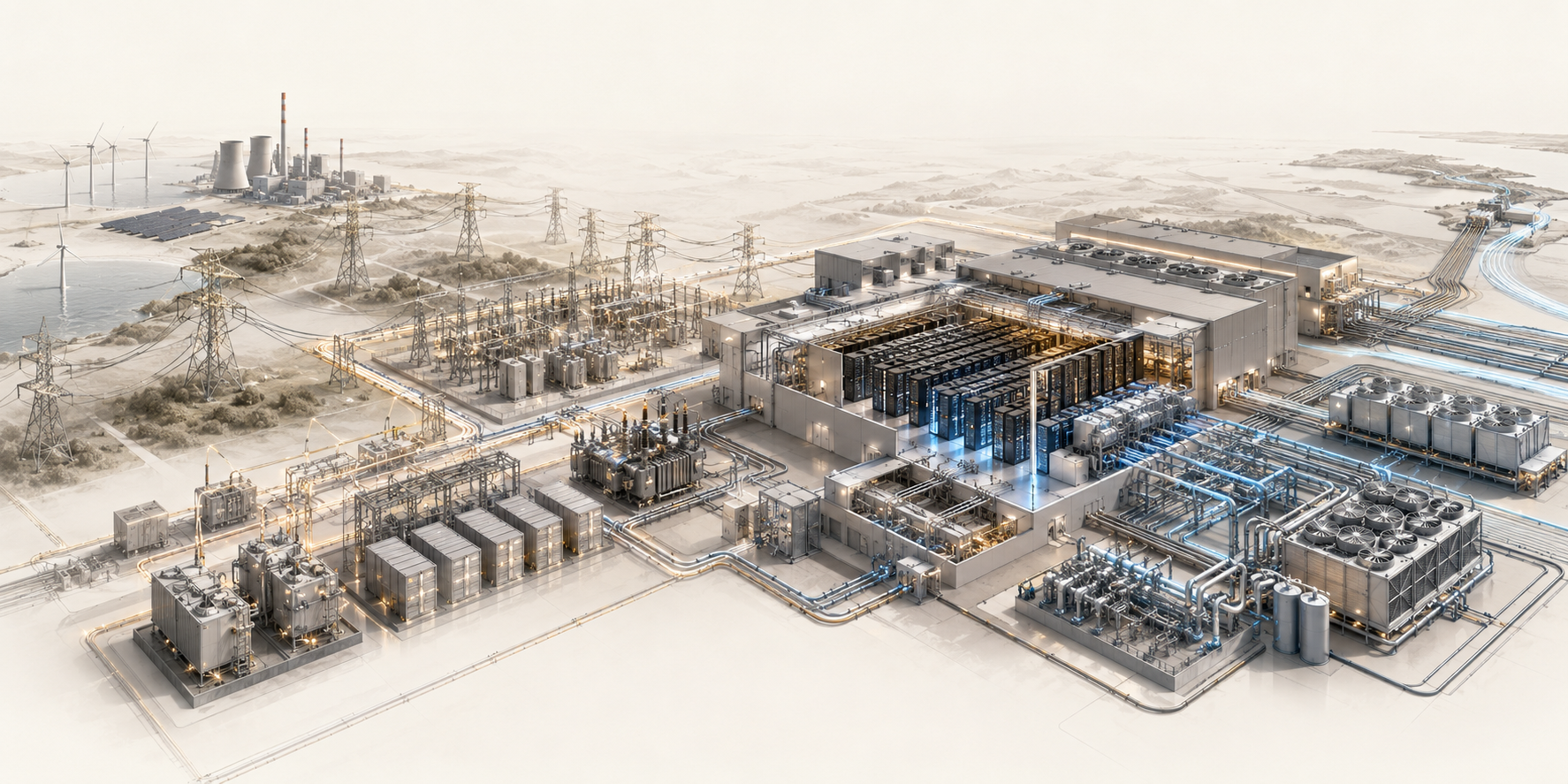
Of all these factors, power is the most important. Planning for AI infrastructure now often starts with the power substation, not just the site itself. Markets that do not update their power grids or find temporary power solutions risk being left behind, no matter how much demand there is.

Investment and M&A Trends: Capital Flows Toward Constraint Resolution

Investors are now focusing more on areas that solve key problems, not just on adding more capacity. These areas include:

  • AI-ready colocation and build-to-suit facilities
  • Specialized GPU cloud providers serving mid-market and enterprise AI demand
  • On-site and bridging power generation solutions
  • Advanced cooling technologies and infrastructure services

M&A activity reflects a search for execution certainty acquiring capabilities that secure power, permits, or technical expertise rather than simply adding scale.

Policy, Regulation, and Sovereign AI Implications

Governments now treat AI data centers as strategic assets. Data sovereignty, national security, and digital resilience are shaping infrastructure policy across regions.

This is increasing demand for national and mixed cloud systems, especially where governments are using more AI. Clear regulations now give a competitive edge, while unclear rules add real risk.

What Stakeholders Commonly Get Wrong About AI Data Centers

A common mistake is to think of AI data centers as one global market. In fact, local challenges are what really shape results.

Another common error is trusting announced capacity numbers too much. Many projects are delayed or changed because of power, permits, or supply chain problems. Relying only on secondhand data can lead to mistakes in timing and expected returns.

Strategic Implications by Stakeholder Group

  • Investors should focus less on growth stories and more on whether projects can actually be carried out and what obstacles they might face.
  • Developers need to consider power, cooling, and permits right from the start of the design process.
  • Governments must align AI ambitions with grid, land, and policy readiness.
  • AI enterprises must evaluate build-versus-lease-versus-cloud strategies through a total-risk lens.

Why Surface-Level Market Data Is No Longer Sufficient

Public market data shows what people plan to do, not what is actually possible. It usually does not include details like power station capacity, connection delays, labor shortages, or cooling systems. In markets where power is limited, these details are what really matter.

This is why thorough, first-hand research is so important.

What the Global AI Data Center Market Research Report Delivers

The Global AI Data Center Market Research Report provides:

  • Region-by-region infrastructure readiness assessment
  • Power, cooling, land, and permitting feasibility frameworks
  • Investment and M&A mapping across the AI infrastructure value chain
  • Policy and sovereign AI implications by geography
  • Scenario-based analysis for investors, operators, and governments

The report is made for board members, investors, and policy leaders, turning complex information into clear, useful guidance for decisions.

Velox Consultants’ Perspectives: From Market Momentum to Execution Discipline

Velox Consultants believes that the biggest risk in the AI data center market now comes from execution, not from the market itself.

Having clear demand and enough money is no longer what sets companies apart. Now, success depends on spotting challenges like power access, grid timing, cooling, labor, and regulations before investing.

India exemplifies this shift within the global system. It is a high-potential market where global best practices must be adapted to local realities. Strategic outcomes depend on granular validation, not generic benchmarks.

Velox Consultants supports investors, operators, hyperscalers, and policymakers by converting macro AI infrastructure trends into decision-grade insights. Our work focuses on the questions that matter most to boards and capital allocators: where capacity can be built, at what cost, within what timeframe, and under what constraints.

How Velox Consultants Supports Stakeholders

Typical engagements include:

  • Market entry and expansion strategy for AI infrastructure platforms
  • Location prioritization and feasibility assessment
  • Investment and M&A diligence across AI infrastructure assets
  • Policy and sovereign AI advisory
  • Scenario modeling for long-term infrastructure risk

All our work is made for top executives and board members to support their decisions.

Frequently Asked Questions (FAQs)

Why are AI data centers fundamentally different from traditional data centers?
Because AI workloads dramatically increase power density, thermal load, and performance requirements, altering site selection, design, and economics.

Why is power now the binding constraint globally?
Grid infrastructure was not designed for sustained AI workloads. Power access, not capital, increasingly determines feasibility.

How should investors view India relative to mature markets?
India offers strong growth potential but higher execution variance. Localized due diligence is essential.

Which AI data center investment themes are most resilient?
Those that directly address constraints—AI-ready colocation, on-site power, advanced cooling, and sovereign infrastructure.

What long-term risk should be monitored?
Decentralized and on-device AI could alter centralized compute demand over long horizons.


Tags
Market Research Technology Marketing Strategy AI Market Analysis Manufacturing Healthcare Retail Fintech Sustainable Energy Renewable Energy MSME Growth MSMEs in Smart Manufacturing Telemedicine Future Of Healthcare IoT Pharmaceutical Food MSME Clusters Clean Energy Sustainability Metaverse Consumer Goods Automotive Power Sustainability in MSME Digital Twin Industry 4.0 India Smart Factory Market Next-Generation Sequencing Space cleantech net zero by 2030 D2C Healthcare industry Artificial Intelligence Retail Marketing Distributed Energy Resources (DER) Branding Agriculture Infrastructure Global FMCG Trends Data Centres & AI Compute Growth Growth Strategy 2025 Delhi FMCG strategy FMCG India India FMCG Strategy Consumer Insights Growth Strategy agri business models agri-tech innovation Retail Innovation market research for SMEs Healthcare Trends Digital Transformation Green Practises in MSMEs Regional MSME Clusters Advanced Manufacturing smart factory Market research trends AI in market research Predictive analytics Medical Equipment AI in Healthcare Electronic Manufacturing Service Genomic Sequencing CRISPR Gene Editing COP 28 Product Market Fit Strategy DeepTech Quantum Computing Biotechnology Space Mining Satellites Bio-fabrication in Space Wearable medical devices Generative AI green hydrogen production future of hydrogen energy Advantages of Hydrogen for Power Generation Hydrogen Production Hydrogen Policy Cybersecurity Engineering smart mobility Supply Chain Entertainment CPG BFSI zero carbon emission wealthtech Insurtech Neo Bank Online Food Delivery Health and wellness Telecom India Economy 2026 Velox Consultants AI in Manufacturing Atmanirbhar Bharat India Pharma 2026 Green Energy India Semiconductor India Consumption to Capability India Business Strategy Viksit Bharat india-uae-business b2b-growth-strategy global-market-entry middle-east-market cross-border-trade india-export-strategy gcc-expansion abu-dhabi-investment dubai-business-opportunities uae-market-entry Supply Chain Localization Export-Oriented Manufacturing Engineering Goods India Pharma & Chemicals Manufacturing Industrial Policy India 2026 MSME Growth Strategy Manufacturing Investment India Gujarat Industrial Clusters India Manufacturing Corridor India Europe FTA sectors analysis Europe expansion strategy for Indian companies Growth strategy for international market entry Market research for Europe expansion India Europe market entry strategy ESG compliance for Europe exports Data Center Market Research AI Infrastructure Strategy Global AI Data Centers AI Investment & M&A Enterprise Digital Infrastructure India AI Infrastructure Sovereign AI & Policy Power & Cooling Constraints Hyperscale & Colocation Wellness Drinks Functional Beverages Export Market Intelligence Consumer Health Trends Food & Beverage Strategy Preventive Health Nutrition Beverage Industry Trends Gut Health Beverages Ayurveda Export Market Die-Cast Aluminium Market High Pressure Die Casting EV Aluminium Components Export Ready Manufacturing Global Aluminium Supply Chain Low Carbon Aluminium Sustainable Aluminium Manufacturing Manufacturing Capacity Expansion Aluminium Battery Enclosures Lightweight Automotive Materials Advanced Die Casting Technologies Structural Aluminium Castings Large Format Die Casting business growth trade policy impact international market entry strategy manufacturing expansion, export growth opportunities global sourcing shift international procurement tariff disruption strategy export diversification global value chains Autonomous Operations Smart Manufacturing Innovation Acceleration Future of Work AI Strategy Enterprise AI Adoption Autonomous Intelligence Agentic AI Skincare Innovation Digital Cosmetics Clean Beauty Beauty & Wellness Anti-Aging APAC Market Cosmetic Trends 2030 Sustainable Skincare AI in Beauty Satiety Economy FMCG Strategy GLP-1 Supply Chain Innovation Functional Foods Consumer Behavior Supplier and distributor intelligence Vendor Intelligence B2B Market Research Engineering Product Market Research Energy Market Research FMCG Market Research Healthcare Market Research Healthcare & MedTech India 2026 Functional Foods & Agri Innovation Green Hydrogen & Clean Energy Transition EVs & Battery Circular Economy India Semiconductor & Electronics Manufacturing India AI SaaS & MSME Digitization India Investment Opportunities Boardroom Strategy India India 2026 Growth Playbook ClimateTech & Carbon Markets India Healthcare Tech Telecom 6G Telecom 5G EV Mobility AI Chips India Semiconductor Market Semiconductors Green Energy Electricals Automation Emerging Markets Smart Factories Cobots over Robots Energy Reliability Gap Green Electricals Smart Cities Green Transport PM E-Drive Battery Swapping Charging Stations India Mobility EV Infrastructure Electric Vehicles Power sector transformation Smart meters and IoT Energy storage and AI Clean energy transition AI smart grids Farmer Empowerment Rural India Pharma Engineering CMO Insights Velox Ascent Matrix Strategic Consulting for Manufacturers MSME Strategy UAE SME & MSME Consulting Marketing Transformation Tier 2 CPG insights Chennai beauty market trends Ahmedabad regional GTM Personalized Wellness Mumbai CPG personalization Regional Marketing Primary Research CPG Trends 2025 India personalization expert healthtech trends 2030 green hospitals quantum-AI drug discovery bio-digital twins global health trends sustainable healthcare systems quantum AI healthcare regenerative medicine insights digital health innovation Sustainable Growth Business Transformation Retail Growth Strategy Consumer Product Strategy B2B Strategy Growth Matrix Velox Framework Startup Consulting MSME Strategy Functional agriculture nutraceutical exports supply chain in agriculture functional food market wellness foods food-tech sourcing India nutrition economy bio-fortified crops Smart Retail Velox Insights AI in Business Future Of Commerce India Retail Trends Retail Growth 2025 Retail Growth Consumer Intelligence Retain AI Strategic Foresight Zero Defect Zero Effect National Digital Twin Predictive Manufacturing Simulation Tech SME Insights MSME Insights Robotic Surgery Healthcare Technology Minimally Invasive Surgery Surgical Robotics Future of Surgery Healthcare Investments Medical Innovation AI Investment Union Budget 2025 Export Global Business Trends DAVOS 2025 economic resilience Intelligent Manufacturing Sustainable Mobility MSME Export Trends Government Schemes for MSMEs Indian Economy Cloud Computing Smart Factory Technologies Manufacturing Excellence Biosimilars Biologics CRISPR-Cas9 AI in Pharma Pharmaceutical Engineering Pharmaceutical Market Trends Sustainable Pharma Advanced Drug Delivery Real-time insights Digital qualitative research Market intelligence Ethical research AI in Green Finance Blockchain for Sustainability Eco-friendly Investments Sustainable Finance Green Fintech Energy Efficiency Smart Grids Quantum Dots Nanobots Nanomaterials Nanomedicine Nanotechnology Nanofabrication Nano-Fertilizers Carbon Nanotubes Quick Commerce E-commerce Data Driven Personalization Healthcare Innovation MedTech Personalized Medicine Digital Health 3D Printing in Healthcare Robotics in Surgery Carbon Storage System Carbon capture technology Robo Advisor Insurance Finance Banking Biotech CRISPR DigitalTherapeutics Decentralized Finance Contactless Payments Open Banking Traditional Banking Embedded Finance Pharma Innovation Digital Therapeutics Patient Engagement Pharma CX Green Electronics Green Technology Mass Customization Micromobility Vehicle-to-grid (V2G) technology Wireless Charging Battery Advancements Powertrain Optimization Emobility Collaborative Robots Microfactory Bioinformatics Pharmacogenomics Disease Prediction Personalised Medicine Genomics ClimateTech Carbon Capture and Removal Sustainable Transportation Circular Economy Market-Fit Strategy D2C Strategy Human-Machine Interaction Digital Thread Edge Computing Genetic Engineering 3D Bio Printing Space Tourism Aerospace Tissue engineering Organ Transplantation Customised Implants Customised Prosthetics Disease Modeling Regenerative Medicine ECG monitors Wearable health Telehealth Mental health monitoring Fall detection Pregnancy monitors Blood pressure monitors Product Design Content Creation chatgpt WEB 3.0 Invest India India Market startups ESG Electronic Waste Construction Waste Agriculture Waste Water Waste Renewable Energy Waste Plastic Waste Semiconductor Use Semiconductor Transport Surveillance Security Logistics drone technology Innovation Virtual Factory nft ev battery recycling co2 emissions automotive and transporat EV Charging Station Electric Car Charger Charging Car Nordics Robo-Advisor Digital Banking Cloud Kitchen B2B virtualclassrooms elearning education edtech Telemedicine Market Size Telemedicine Market Growth Telemedicine Market Telemedicine Benefits Reshape the Healthcare Internet of Things 3-D Printing Textile Crude Steel Capital goods Automobile Airports Steel Customer Acquisition Tractor IT Pricing Strategy 5 Cs PESTEL Analysis SWOT Analysis 8 Ps